I’m quite fond of breathing. I’m also rather fond of sleeping. Having lived with two Philips 600 Series air purifiers, I discovered that even buying from a brand I trust doesn’t necessarily mean I can enjoy both at the same time.
To be fair, my first two purifiers really did improve the air in my home. I’d bought them because my pet rabbits were making breathing indoors rather less enjoyable, and the difference was substantial. The trouble was the relentless beeping whenever the settings changed, whether manually or on a schedule, which Philips confirmed couldn’t be disabled. Not ideal for something I wanted beside me while I slept.
When I needed a third purifier specifically for the bedroom, I wasn’t quite ready to give up on Philips. I chose the PureProtect Mini 900 Series AC0950/10, hoping for the same effective air cleaning with better construction, more intelligence and a lot less unnecessary noise. This time, I think Philips has got the balance right.

A properly premium-feeling purifier
Let’s be realistic about what an air purifier is. At heart, it’s a plastic cylinder with holes in it, a filter and a fan moving air through the lot. There are only so many ways to make that look and feel exciting. Even so, the 900 feels noticeably more premium than the basic models I’ve used. The construction seems more substantial, the design details are more intricate, and nothing about it gives me quite the same feeling of having bought the cheapest possible trim level.
One small detail I particularly appreciate is underneath the unit: it actually has proper rubber feet. The cheaper 600 had moulded recesses where rubber feet should have been, but no actual rubber feet. It reminded me of the blank switches on the dashboard of a basic-trim car, each one helpfully pointing out a feature you didn’t pay for. With the 900, Philips has at least finished the job.
I’d expect those rubber feet to help dampen vibrations rather than passing them straight into whatever the purifier is sitting on. I haven’t measured the difference they make, but they’re a sensible touch on a machine designed to run quietly in a bedroom, and they add to that more polished feel.
A fancy touch display that I usually turn off
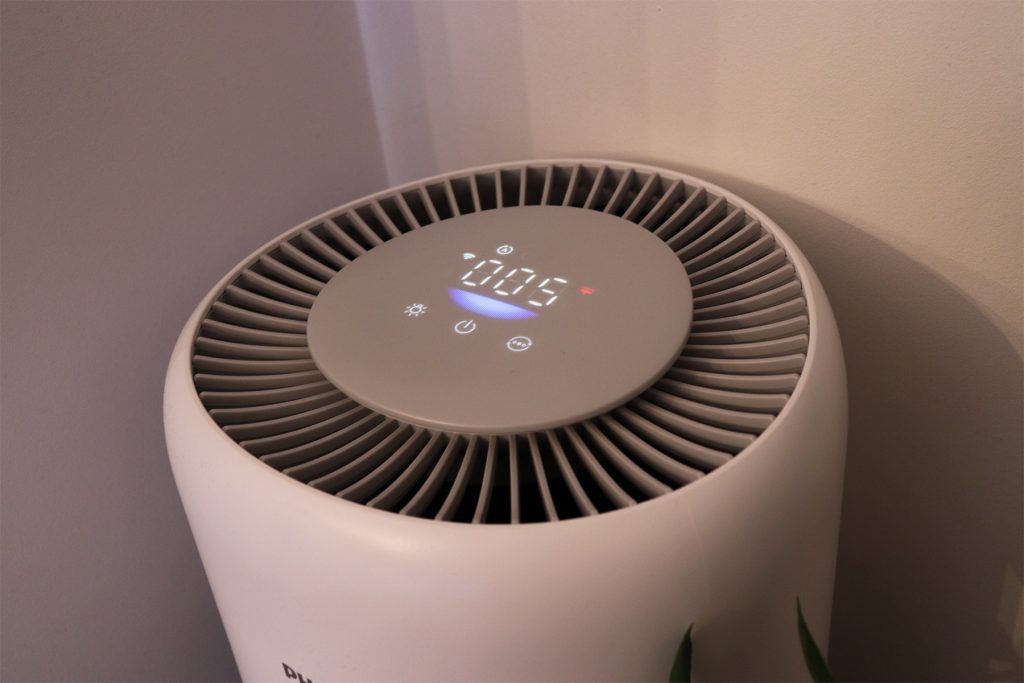
The illuminated touch controls and air-quality display on top look rather nice. There’s coloured feedback about the air, and the whole thing feels more thoughtfully designed than a row of basic buttons. But in practice, I keep the display switched off. I don’t need to stand there watching the purifier tell me it’s working, because I trust it to get on with the job. More importantly, I want a dark bedroom when I’m trying to sleep.
There is a useful red brush icon that lights up when the main filter needs cleaning. The Philips Air+ app reminds me about it too. As you’ll notice in my photograph, that reminder is currently doing its best to tell me something I should probably deal with.
Does it actually clean the air?
There’s always going to be dust, pollen, pollution and all sorts of other airborne muck floating around. And if the air purifier doesn’t catch it, some of it may end up going through my own air filter instead: my lungs. Personally, I’d much rather have the Philips doing as much of that filtering as possible than leaving my lungs to deal with the lot.
So, yes, it does, and that’s still the most important part of the whole thing. My experience with air purifiers began with noticeably easier breathing and fresher-feeling air at home, and the 900 continues to do the job without making a fuss. That’s what I’ve experienced living with these machines, rather than a claim based on laboratory testing.
Philips rates the AC0950/10 at a clean air delivery rate of 250 m³/h, compared with 170 m³/h for the 600 Series. On paper, that’s a useful increase in capacity, and it’s nice to know the more expensive model isn’t simply charging extra for a prettier control panel.
The filtration is more sophisticated as well. The 900 has a three-stage filter combining a pre-filter, Philips’ NanoProtect HEPA filtration and activated carbon. Philips says the carbon layer helps reduce certain gases and volatile organic compounds, alongside the airborne particles dealt with by the other layers. I like that there’s a tangible difference in what the filter is designed to do.
The replacement is the Philips FY0910/30 filter. Philips gives a replacement interval of up to roughly a year, depending on use and air conditions, with periodic cleaning in between. As with any air purifier, filters are an ongoing expense. That’s worth allowing for when deciding what you’re willing to pay for cleaner air.
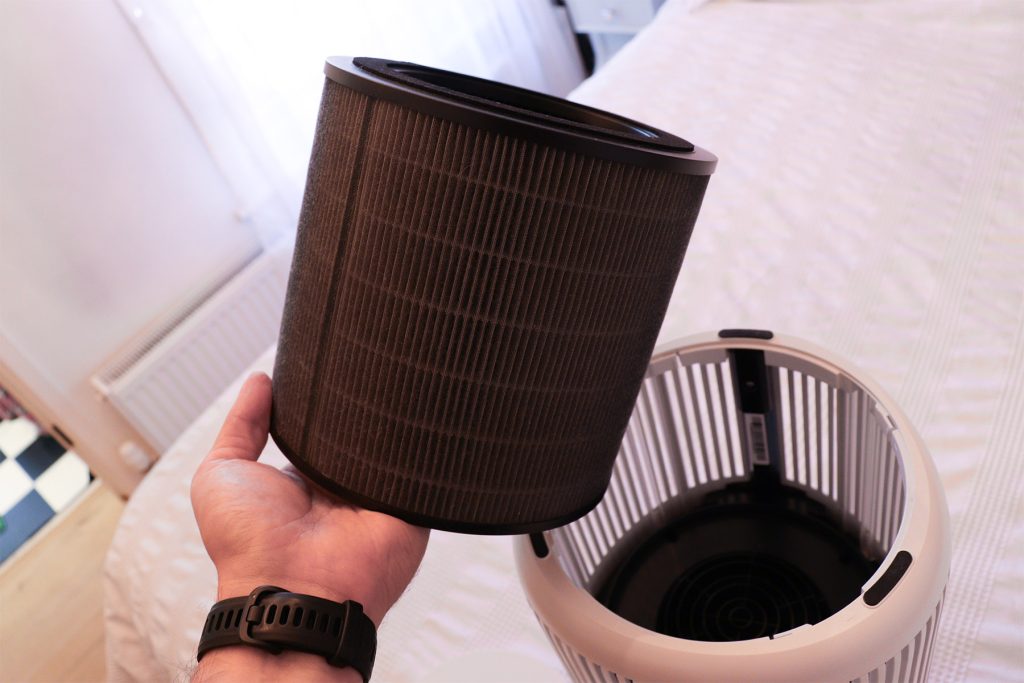
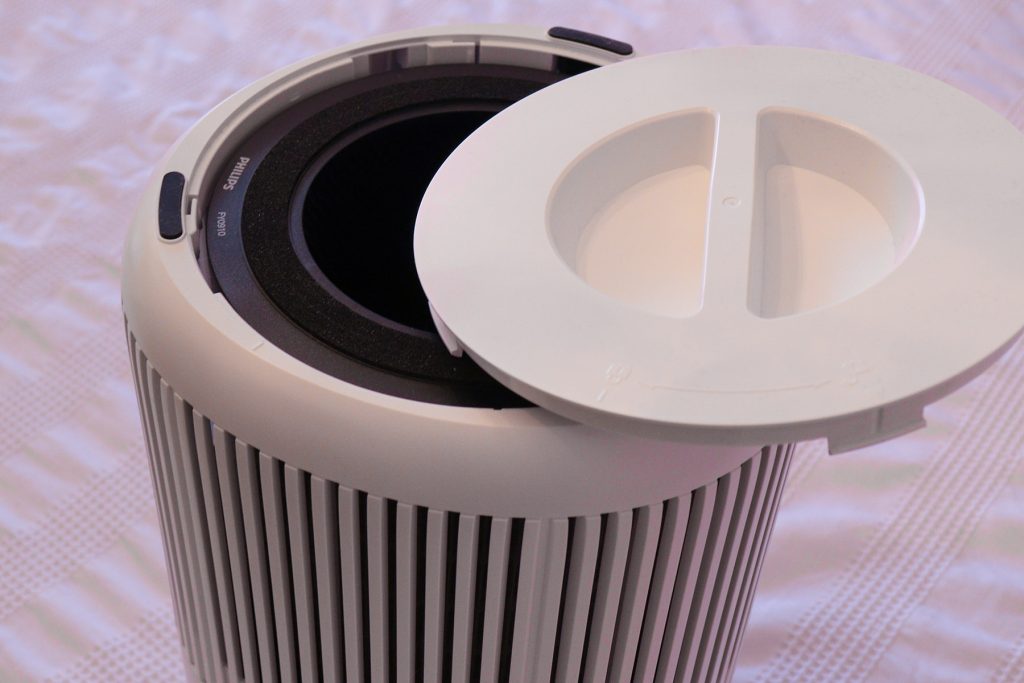
The 900’s filter has substantial rubber seals at both ends to help keep air moving through it rather than around it. The 600’s filter has no such seals; there’s only some cheap foam on the back of its lid. So this isn’t just a difference in filtration material. The 900 also has a more substantial way of sealing the filter against the housing, which, judging by what I could see, should make it harder for dust to sneak around the edges.
I also removed the filter and photographed the inside of the purifier close-up. And yes, I know: I’m a little sad for doing so and need more hobbies in my life. Even though the filter was somewhat dusty, the inside of the purifier was genuinely very clean after months of use. That was a pleasant surprise. I can’t follow individual particles through the machine or call this a scientific efficiency test, but a dusty filter alongside an impressively clean interior is reassuring. It’s one of those less glamorous design details I appreciate far more once I’ve actually opened the thing up.

Automatic cleaning that actually earns its keep
The thing that really makes the 900 enjoyable to use is Auto mode. Instead of having to decide when the fan should work harder, I leave it to the purifier. It monitors the air, adjusts its own speed and then settles down again when things are back to normal. I leave mine on Auto almost all the time, simply because I haven’t found much reason to interfere.
Spray a little perfume or hairspray nearby and it notices almost immediately. The fan speeds up, sometimes quite enthusiastically, and then slows down again once the sensor is satisfied. It’s surprisingly satisfying to watch something react so quickly to what’s happening in the room rather than simply running at whatever speed I told it to use earlier. I can hear it responding, and then hear it becoming quiet again.
With this automatic mode, I don’t need to work out a schedule based on when I think the room might need more cleaning. I can plug it in, pop it on Auto and forget it. That’s the kind of smart feature I want in a household appliance: one that takes a job away rather than creating another thing for me to configure.
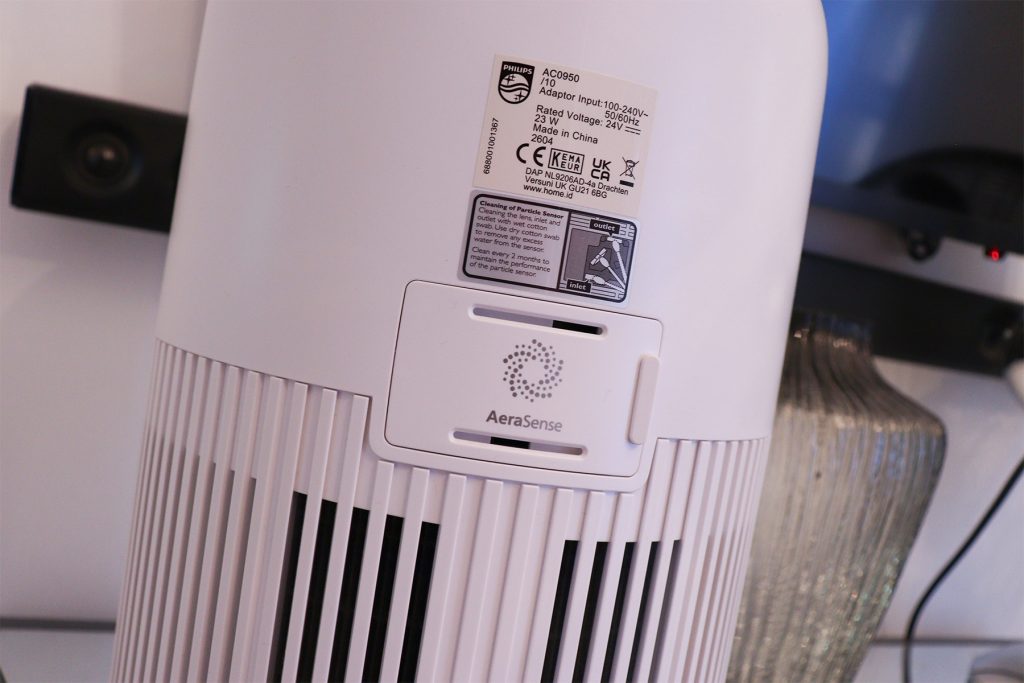
The AeraSense particle sensor responsible for monitoring airborne particles has its own access hatch at the back, which you can see below. It can be cleaned separately from the main filter, and I like that arrangement. If I’m trusting a machine to make decisions about my air quality, I want to be able to keep the sensor itself clean. It’s a separate little maintenance job, but at least Philips has made it accessible.
Quiet enough to forget it’s running
When the air is clean and the fan slows down, the 900 is almost inaudible to me. It’s even less noticeable in my bedroom than the 600 was on its lowest setting, and that was already fairly quiet. Of course the 900 gets louder when it detects something and speeds up. That’s not a complaint. It’s doing the job, and then going quiet again once it’s finished.
Even though there is a dedicated Sleep mode, I generally leave it on Auto because that works so well for me. The important thing is that the 900 can quietly get on with its business, without the 600’s maddening beep every time the fan speed changes. I wanted something that would let me breathe and sleep, preferably at the same time, and this one manages it.
An app I don’t have to keep opening
I’ve always found the Philips Air+ app quite good. I can see what the purifier is doing, change the settings remotely and get reminders about cleaning or replacing the filter. With the 900, though, automatic sensing makes most of the decisions, so I don’t need to keep opening the app. It’s useful when I want it, rather than another thing I have to keep checking. I like that it doesn’t turn air purification into a hobby.
That said, the app has some extra information if you’re curious about the air beyond the room itself. It shows outdoor pollution and local pollen levels as well, which is pretty neat, I suppose. If I remembered to look at them, that is.
About the size
Now for the less glamorous practical consideration: the 900 is still a substantial thing to have in a bedroom. Philips calls these purifiers compact, but we’re talking about a fairly large cylinder, not a tiny bedside-table ornament. On many bedside tables it would take up most of the available space, assuming it fits comfortably at all.
To be fair, there are sensible reasons for the size. An air purifier needs to move a useful amount of air through a filter, and the filter needs enough surface area to do that job. Make the whole thing too tiny and you’re asking it to push air through a much smaller area, which isn’t necessarily going to help with noise. I understand why it has to be this big. Understanding it doesn’t suddenly make my furniture any bigger, though.
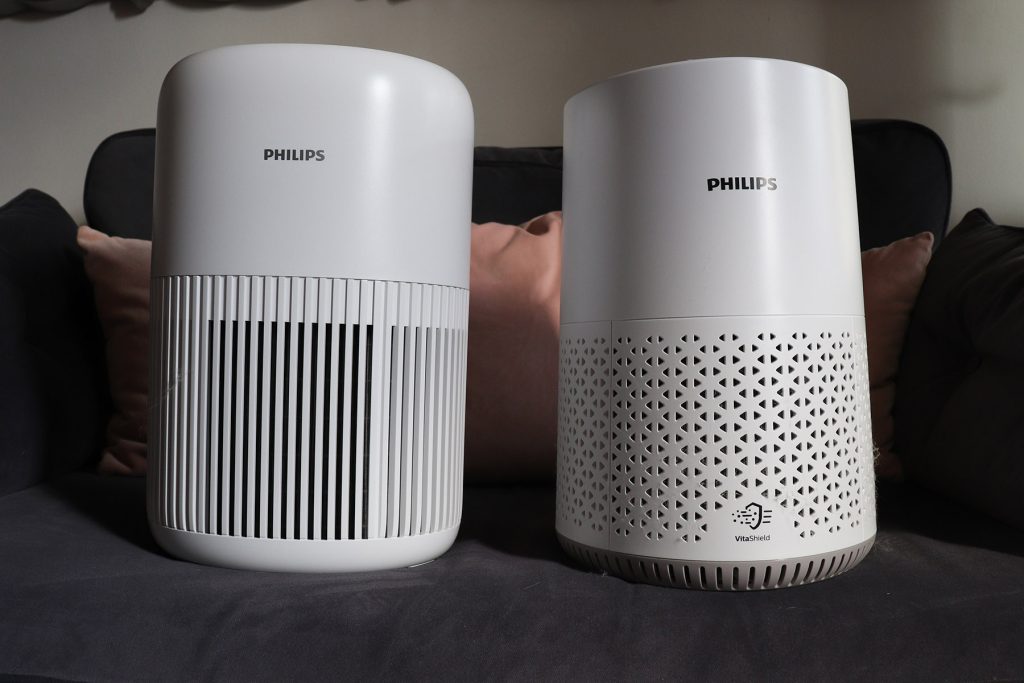
I photographed the 900 and 600 next to each other on the sofa, and they look rather like two toddlers sitting there watching TV, each taking up a small child’s share of the sofa. It’s a ridiculous comparison, but it gives a pretty good idea of their actual size. The 900 is slightly taller, yet their footprints are practically identical. In everyday terms they take up the same amount of space. If you’ve got room for one, you’ve effectively got room for the other. If you haven’t, neither model is going to solve that problem for you.
Would I recommend it or buy it again?
Yes, and yes. The 900 does the job I bought it for and is a pleasure to live with. It reacts when the air needs attention, becomes almost inaudible when it doesn’t, and leaves me free to get on with my day or get some sleep. The controls are nicely made, the lights can be switched off, and the filter design feels properly thought through. Most importantly, I can actually breathe and tell the difference.
It is still quite large, and I still have to clean the filter and eventually buy another one. And when it’s working hard, it’s obviously not silent. But none of those are surprises or reasons for me to dislike it. The automatic sensing, quiet everyday operation, more premium construction, proper rubber feet and well-fitting filter seals are all details that actually matter to me. Those improvements are worth their weight in gold.
I’ve said in my Philips 600 Series review that the cheaper model does clean the air well, and that I still own and use two of them. But the 900 is a massive improvement in how pleasant an air purifier is to own, particularly for a bedroom. I’d be extremely happy to buy another one instead of saving a bit of money on another 600. An air purifier should make life more pleasant, not interrupt it. If you like breathing, you’ll probably appreciate having one. If you also like sleeping, this is the Philips I’d choose.