The UK is too f*cking humid. And if, like me, you dry your laundry indoors, a decent dehumidifier is one of those household appliances that makes an enormous difference. The Bosch Dry 4000 is easily one of my favourite household purchases. It’s powerful, reasonably compact, pleasant to have running and, most importantly, it does exactly what I bought it to do.
Why I Bought the Bosch Dry 4000
The Bosch replaced my Pro Breeze 12L/day dehumidifier, which I’d used for years. The Pro Breeze had done its job, but because it didn’t have a proper filter, its internals had become thoroughly gunked up. I’d even taken it apart and cleaned it, but there was only so much I could do. Dust and other airborne particles inevitably make their way into the machine, and when you’ve got moisture and condensation involved, they have a wonderful habit of sticking to everything.
When you’re replacing something because it hasn’t held up particularly well, reliability naturally becomes a priority. Bosch is one of the brands I trust, so that’s where I started looking. I also wanted something with a proper filter and enough capacity to get the job done efficiently rather than having to struggle away all day. That led me to the Dry 4000, the most powerful of the three models I was considering: the Dry 1000, Dry 2000 and Dry 4000.

More Powerful Than I Need? That’s the Point
The Dry 4000 is rated for rooms up to 33 m², whereas the room I mainly use it in is roughly 3 × 4 metres, so about 12 m². Obviously, that’s considerably more capacity than the room itself requires, but I’d much rather have a machine that’s a bit too powerful than one that’s constantly working at its limit. It can remove moisture efficiently, and because air circulates around the house anyway, the benefits aren’t confined to the room where the dehumidifier is sitting. Even the shower room a couple of rooms away benefits from having it running.
And it’s not as if the Dry 4000 is some enormous industrial machine. It remains a perfectly reasonable size for an ordinary room, without dominating the space.
Drying Laundry Is Where It Really Earns Its Keep
The Dry 4000 works extremely well at removing moisture. Bosch advertises a maximum extraction capacity of up to 16 litres per day, and while I haven’t conducted any scientific measurements, based on how effectively it works, I’ve absolutely no reason to doubt its capabilities. You can use the automatic and sleep modes, set a target humidity, or use the dedicated laundry-drying function, which starts at full power and has an eight-hour shut-off timer by default. That last option is absolutely excellent.
Indoor laundry drying is a fact of life in the UK, and without a dehumidifier, hanging a full load of washing up to dry can mean waiting two or three days before everything is actually dry. It’s not just inconvenient because your clothes take longer to dry. It also limits how much laundry you can wash in the first place. Instead of properly filling a clothes horse, you might have to spread things out and wash a fraction of the amount at a time, otherwise everything just sits there damp for days.
With the Bosch, I can fill the clothes horse properly, switch on the drying function and get on with other things. It makes it perfectly practical to live without a tumble dryer, and hanging clothes to dry is generally kinder to them anyway. There’s also the wider benefit of controlling humidity in the house, reducing the conditions that encourage mould and damp rather than simply allowing all that moisture to hang around indoors. For me, this is one of those appliances that earns its place in the household many times over.
Dry 1000 vs Dry 2000 vs Dry 4000: More Power, Same Size
Would I choose the Dry 1000 or Dry 2000 instead? Absolutely not. And no offence to either of them, but they’re rather pointless in my eyes. The Dry 1000, Dry 2000 and Dry 4000 all have the same external dimensions, with less than a kilogram separating the lightest and heaviest. There’s no meaningful space saving to be had by choosing the less powerful model. When I checked the prices in October 2026, the Dry 1000 was £159, the Dry 2000 was £179 and the Dry 4000 was £219. That makes the Dry 4000 approximately 38% more expensive than the Dry 1000, while its advertised maximum moisture extraction capacity is 60% higher: up to 16 litres per day instead of 10. Now, that doesn’t mean every load of laundry will dry exactly 60% faster, but why deliberately choose the lower-capacity machine when the price difference is relatively modest and the machine takes up exactly the same amount of space?
The time saved is worth something too. It’s not just a matter of whether your clothes will eventually dry, but whether you can get the washing done, have everything dry and put away the next day, and get on with your life. Having wet clothes occupying half a room for days isn’t exactly my idea of convenience. I’d rather pay the extra money for the additional capacity and be done with it. Just get the Dry 4000.
Airflow and Noise: Surprisingly Pleasant
One of the nicest things about the Dry 4000 is how it moves air around the room. Rather than blowing directly at you or whatever happens to be in front of it, the air exits upwards through the top of the machine. This gives a much nicer distribution of dry air without making it feel like you’ve got a conventional fan blowing across the room.
Something else I noticed is that, looking through the top grille, the fan appears to be a centrifugal type rather than a conventional axial fan. Bosch doesn’t explicitly confirm this in the specifications I’ve seen, but I can actually see the fan inside the machine. Whatever the precise arrangement, the result is a really smooth, low hum that’s surprisingly unobtrusive.
And that’s an important distinction. I’m not saying the Bosch is silent, because it certainly isn’t. What I am saying is that the sound it produces simply isn’t particularly annoying. With my old Pro Breeze, you could quite clearly hear the compressor kicking in, accompanied by that rather unpleasant change in mechanical noise. With the Bosch, I genuinely struggle to notice the compressor engaging at all. There’s a subtle refrigerant-compressor sound, but nothing like the dramatic startup noise I was used to. It feels much more refined, and this is one of the things that makes the Bosch worth the extra money to me. I can happily have it running in the next room, or even in the same room with sleep mode enabled.
The Optional Filter Should Really Be Included
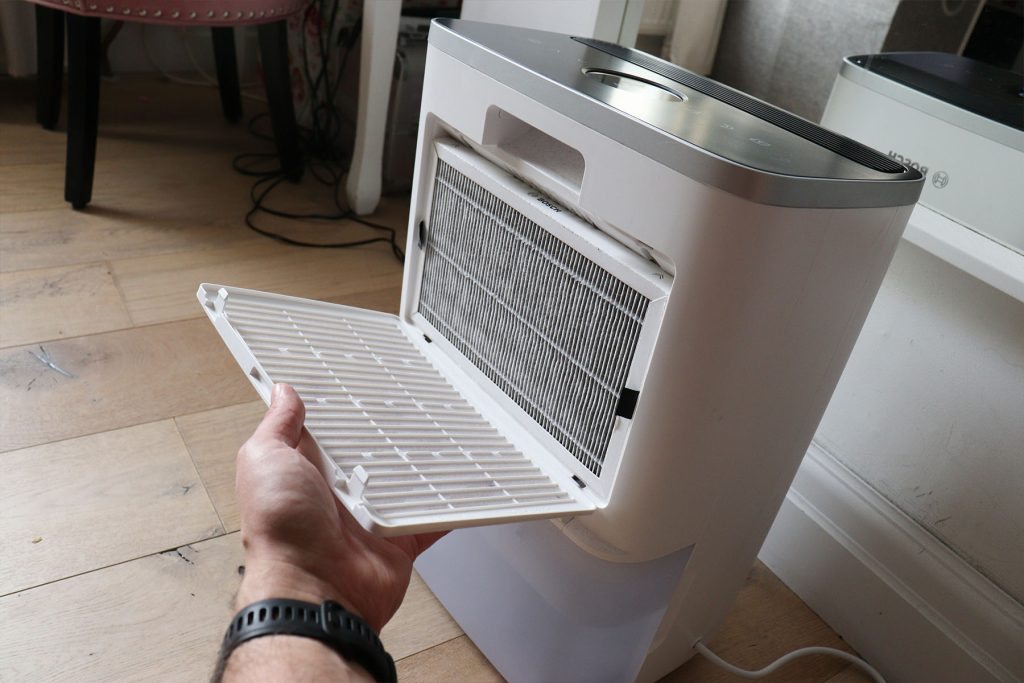
One of my main reasons for choosing the Bosch was the ability to use a proper filter, not just to clean the air passing through the machine but also to help protect its internals from dust, hair and other particles. After seeing what happened to my Pro Breeze, I really didn’t fancy repeating that experience. The Dry 4000 has a removable plastic mesh screen at the back, and you can operate it without the additional filter, but I wanted the extra protection from day one.
Annoyingly, the HEPA and activated-carbon filter isn’t included with the dehumidifier. You have to buy it separately, and it comes as a two-pack. I bought mine immediately rather than running the machine without one and allowing dust to start accumulating inside. Given that filtration helps protect the machine as well as improve the air passing through it, I think including at least one filter would have been a sensible thing for Bosch to do.
On the positive side, I’ve used the same filter for around ten months without needing to replace it. Whenever I hoover, I remove and clean the rear mesh screen and give the filter a gentle going-over to remove the larger particles collecting on its surface. My thinking is that there’s little point leaving a layer of dust sitting there if you can easily remove it. In my conditions, I reckon a filter could realistically last around a year with sensible maintenance, although that’s my own experience and estimate rather than Bosch’s official replacement interval. Either way, the two-pack should last me a good while.
More importantly, I feel much better knowing that the filter is helping to keep airborne muck out of the machine. A dehumidifier constantly pulls air across components where moisture condenses, which makes accumulated dust particularly undesirable. I obviously can’t guarantee that the Bosch will remain spotless inside forever, but at least I’m doing something to avoid the same fate as the old Pro Breeze.
Practical Details and a Few Minor Niggles
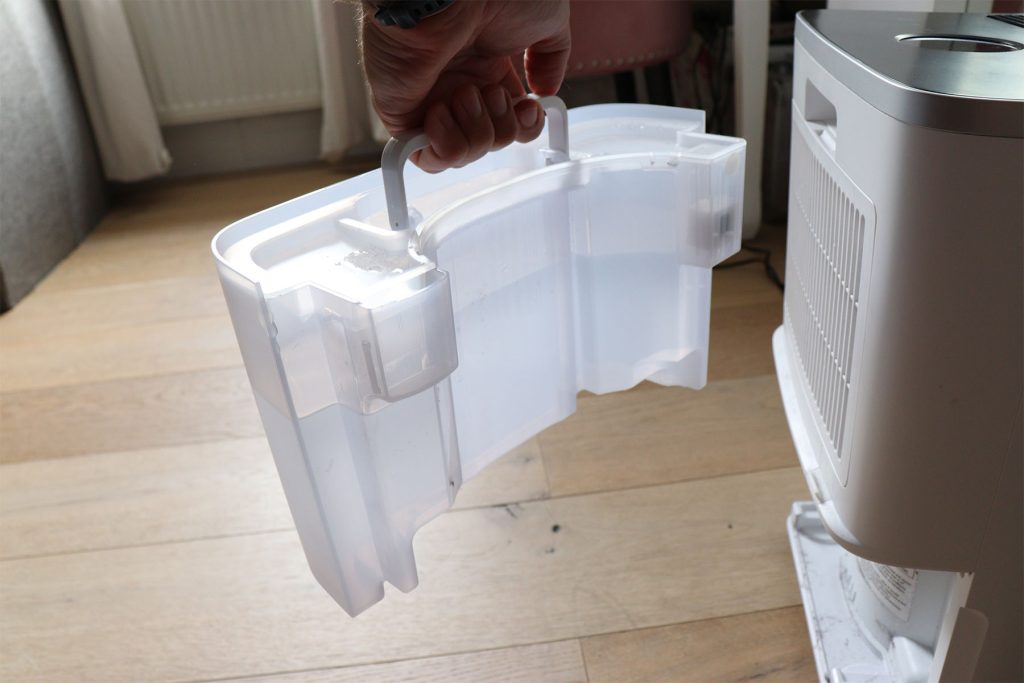
The water container itself is nicely made. It’s easy to remove, has a good, sturdy handle and doesn’t feel flimsy. You can see the water level from the sides of the machine, although it’s less obvious when looking directly at the front.
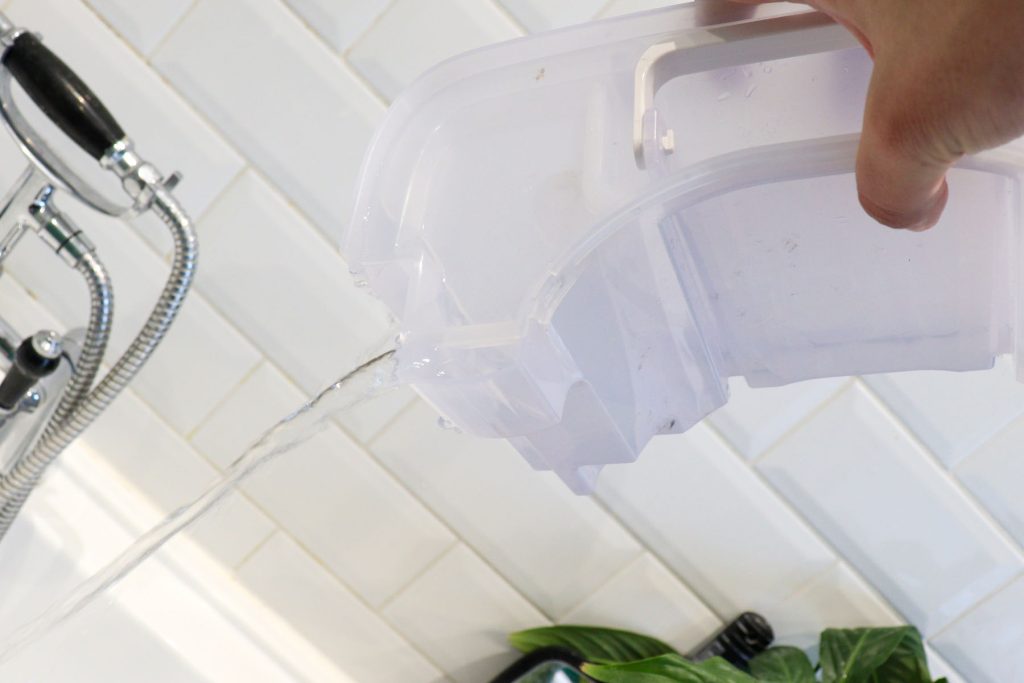
The one slightly irritating detail is actually emptying it. There’s a particular angle at which the water pours out neatly, but if you just tip the container over without thinking about it, water can escape from various little nooks and crannies instead of coming out in one controlled stream. It’s easy enough once you’ve got the hang of it, but the pouring arrangement could have been designed a little better. There’s also an option for continuous drainage if you’d rather not empty the container manually.
One small concern I had when choosing the Bosch was that my old Pro Breeze had a swivelling carrying handle, whereas the Bosch doesn’t have such an obvious one. As it turns out, the Bosch has good-quality wheels and a discreet recessed grip at the back if I do need to lift it. That’s much better design than having a handle taking up half the top of the machine. The water container is the only part I need to carry regularly, and that already has a proper handle. Besides, looking back, the Pro Breeze’s carrying handle mostly came in handy when I took the thing to the local recycling centre.
The other tiny oddity is the power cable, which exits from the side rather than the back. I understand why, given that the water container is accessed from the rear, but I do find the cable gets in the way a little more than it would if it came straight out of the back. Again, hardly a reason not to buy the machine.
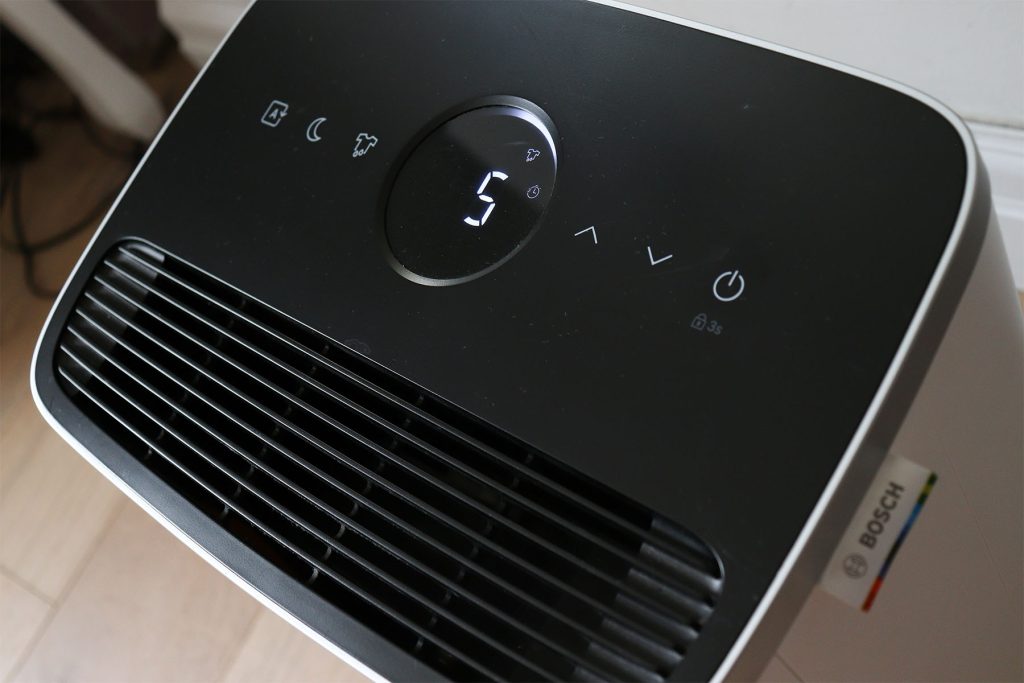
Finally, the plastic touch controls on top look very neat, with a glossier section for the display, but that surface can scratch if you’re careless when cleaning it. In fairness, mine picked up only a very slight scratch because someone with apparently no regard for things bought by other people decided to run a vacuum cleaner over it without the brush. That’s hardly a reasonable test of scratch resistance. Almost anything would scratch under those circumstances. Use a soft cloth and a bit of common sense, and there’s no reason why it shouldn’t continue looking good. I certainly wouldn’t hold that incident against the Bosch. With that said, the black top does show a bit of the dust that may have landed on it.
Would I Buy the Bosch Dry 4000 Again?
100%. I’d recommend it without hesitation, and if I ever needed another dehumidifier, I’d happily buy another Dry 4000. Yes, it’s more expensive than the smaller models, and running a dehumidifier obviously has an electricity cost, but the performance, convenience, reliability-focused design and unusually pleasant operating noise make it well worth the money in my eyes.
The water container could pour a little more neatly, the power cable could be in a better position, and Bosch really should have included the filter. But these are minor details compared with how well the machine actually does its job. For a country that’s far too humid, a good dehumidifier isn’t something I’d want to be without, whether I’m drying clothes indoors or not. The Dry 4000 is an excellent product, and easily one of the household appliances I’d put on my recommended list. If you’re choosing between the three Bosch models, my advice is simple: get the Dry 4000. You can dry your laundry without spending half your life waiting for it, while also helping keep condensation off the windows and mould at bay.